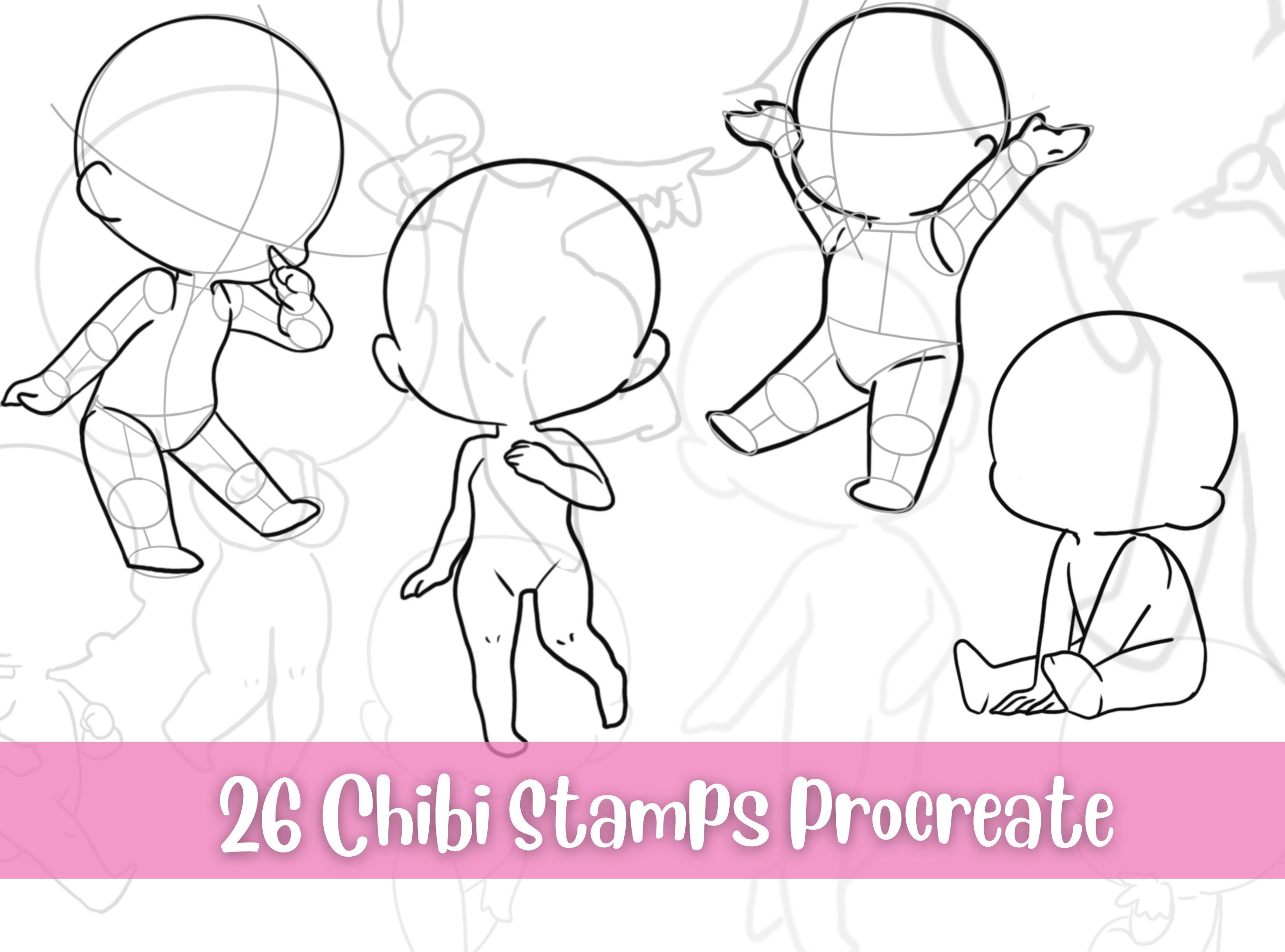
Chibi poses are stylized character stances characterized by exaggerated proportions, typically ranging from two to three heads in total height. These poses prioritize emotional expression and "kawaii" aesthetics over realistic anatomy, using simplified shapes and a strong line of action to convey personality through compact, dynamic, and often humorous movements.
Understanding the Fundamentals of Chibi Proportions
To master chibi poses, one must first understand that "chibi" (derived from the Japanese word for short or small) is not just a "small person" but a specific aesthetic system. In 2026, the standard for character design often categorizes chibi styles by their "head-to-body" ratio. Unlike a standard human figure, which is seven to eight heads tall, a chibi figure is fundamentally defined by its oversized head and diminutive limbs.
The 2-Head Ratio (Super Deformed)
The 2-head ratio is the most extreme form of chibi. In this style, the head is exactly the same size as the rest of the body combined. Because the body is so small, poses in this category must be exceptionally clear and bold. There is very little room for complex joint articulation, so the pose relies on the silhouette. If a character is running, the legs might become simple "V" shapes, and the arms might be "nub-like." This ratio is frequently used for stickers, emotes, and simple merchandise because it remains legible even at very small sizes.
The 2.5-Head Ratio (Balanced)
This is the "sweet spot" for many modern illustrators. The head takes up one unit, while the torso and legs occupy one and a half units. This extra half-head of height allows for more defined knees and elbows. Poses in this style can be more nuanced, allowing for crossed legs, sitting positions with bent knees, or characters holding objects with both hands. It retains the cuteness of the super-deformed style while providing enough "real estate" for more expressive body language.
The 3-Head Ratio (Elegant Chibi)
Often seen in modern "gacha" game sprites and high-end collectible figures, the 3-head ratio provides a more slender look. The body is twice the length of the head. This allows for sophisticated action poses, such as mid-air combat maneuvers or complex dance steps. While still distinctly chibi, the limbs have enough length to show clear forearms and calves, making it the preferred choice for artists who want to blend traditional anime action with chibi cuteness.
The Core Concept: The Line of Action and the "Bean" Shape
A common mistake when drawing chibi poses is treating the character like a rigid doll. Even though the body is small, it must remain fluid. The Line of Action is an imaginary curve that runs through the character's spine and down through the dominant leg. In chibi art, this curve is often more pronounced than in realistic art to compensate for the lack of limb length.
Implementing the "Bean" Torso
Professional illustrators often use the "bean" method to establish a chibi’s torso. Instead of drawing a ribcage and a pelvis separately, you draw a single, flexible bean shape. When a chibi character leans or twists, the bean "squashes" on one side and "stretches" on the other. This creates a sense of weight and life. When posing a chibi character in an aggressive stance, the bean should lean forward sharply; for a relaxed or lazy pose, the bean should slouch or curve backward.
Gravity and Weight Distribution
Despite their oversized heads, chibi characters must feel grounded. The "center of gravity" for a chibi is typically higher than a human’s—usually near the base of the neck—because the head is the heaviest component. When drawing a walking or running pose, the torso must lean significantly forward to "pull" the weight of the head along. If the character is standing still, the feet must be placed directly under the center of the head to avoid looking like they are about to tip over.
Categories of Chibi Poses and Their Emotional Impact
Choosing the right pose depends entirely on the character's personality. Because chibis have limited facial real estate and limb length, the entire body must act as an exclamation point for the character's mood.
1. Energetic and Action Poses
In energetic poses, "negative space" (the empty space around the character) is your best friend. To show a character jumping for joy, the arms and legs should be spread wide, forming a "star" shape. This creates a clear, readable silhouette. For combat poses, use sharp angles. Even though a chibi’s legs are short, a "lunging" pose can be achieved by tucking one leg close to the body while extending the other straight out toward the viewer (foreshortening).
2. Shy and Reserved Poses
To convey shyness or vulnerability, the pose should "collapse" inward. This is often achieved through pigeon-toed feet (toes pointing toward each other) and arms pulled close to the chest or face. Tucking the chin into the collar or hiding part of the face behind a hand enhances the "moe" aesthetic. The goal is to make the character occupy as little space as possible.
3. "The Tsundere" and Aggressive Poses
Aggression in chibi form is often humorous. To show anger, use a "V-shape" for the arms (hands on hips) and tilt the head downward so the character is looking "up" at the viewer from under their brow. Crossed arms are a staple, but because chibi arms are short, you often have to cheat the anatomy by drawing the hands tucked under the armpits rather than fully wrapping the arms around each other.
4. Resting and Comfy Poses
Sitting or lying down poses are challenging because the head often gets in the way. When a chibi sits, their legs often stick straight out because they aren't long enough to dangle over the edge of a chair. For a "sleeping" pose, the character is often drawn curled into a ball, where the head and the body are almost indistinguishable, creating a "nugget" effect that maximizes cuteness.
Technical Execution: Simplification of Limbs
When drawing chibi poses, you must decide how much anatomical detail to include. As of 2026, the trend has shifted toward "mitten hands" and "tapered feet."
- Hands: Instead of five distinct fingers, many artists use a "mitten" style where only the thumb is separate, or even a simple "nub" for the 2-head ratio. This prevents the hands from looking cluttered in complex poses like "peace signs" or "pointing."
- Feet: Chibi feet rarely have toes unless the character is barefoot and the scene specifically requires it. Usually, the leg tapers down into a rounded point or a small, flat-bottomed shape resembling a shoe.
- Joints: While knees and elbows exist, they are often drawn as soft curves rather than sharp points. In a "bent arm" pose, the elbow should be a gentle arc to maintain the "squishy" feel of the character.
Comparison of Chibi Posing Styles
The following table compares how different chibi ratios handle specific posing requirements:
| Feature | 2-Head Ratio (Super Deformed) | 2.5-Head Ratio (Standard) | 3-Head Ratio (Detailed/Action) |
|---|---|---|---|
| Limb Articulation | Minimal; legs and arms are "stubs." | Moderate; elbows and knees are visible. | High; clear definition of joints. |
| Seated Poses | Legs usually stick straight out. | Can sit cross-legged with some overlap. | Can sit in complex "tucked" positions. |
| Weapon Handling | Weapons are often larger than the body. | Weapons are scaled 1:1 with height. | Weapons look natural and proportional. |
| Silhouette Clarity | Extremely high; must be readable. | Balanced; allows for overlapping limbs. | Moderate; relies on anatomical flow. |
| Best Use Case | Stickers, Emotes, UI Icons. | Manga, Webcomics, General Art. | 3D Models, Action Figures, Games. |
Utilizing Modern Tools for Chibi Poses in 2026
The landscape for artists has evolved significantly. While traditional sketching remains the foundation, digital tools now offer specialized features for chibi creators.
3D Reference Models
Software like Clip Studio Paint and specialized mobile apps now feature "Chibi Primitives." These are 3D mannequins with adjustable head-to-body ratios. These tools are invaluable for checking the "center of gravity" in complex poses, such as a character leaning over a ledge or performing a mid-air kick. By rotating the 3D model, you can ensure that the oversized head doesn't obscure the vital parts of the body language.
Perspective and Foreshortening
Even in a simplified style, perspective is vital. In 2026, many digital brushes and grids are designed to handle "fisheye" perspective, which is popular for chibi action shots. When a chibi punches toward the "camera," the hand might be drawn as large as the entire head, while the rest of the body shrinks away. This "extreme foreshortening" creates a sense of impact that makes the character feel powerful despite their size.
Common Pitfalls to Avoid
Even experienced artists can struggle with chibi poses if they don't respect the unique logic of the style.
- Stiff Necks: The neck is the most important joint in a chibi. If the head is just "floating" on the torso, the pose will look like a figurine rather than a living character. Always ensure there is a clear connection, even if the neck is just a small cylinder.
- Over-detailing: Adding too many muscles or realistic folds in clothing can create a "creepy" or "uncanny" effect. Keep the folds to a minimum, focusing only on the "stress points" where the body bends (the inner elbow, the waist, etc.).
- Ignoring the Silhouette: A good chibi pose should be recognizable even if you fill the entire character in with solid black. If the limbs are too close to the body, the character becomes a shapeless blob. Use "outward" movements to keep the silhouette clean.
- Inconsistent Scale: If you are drawing multiple chibis together, ensure their head-to-body ratios match. A 2-head chibi standing next to a 3-head chibi can look like they belong to different universes unless the difference is an intentional part of the character design.
FAQs About Chibi Poses
How do I make a chibi pose look "dynamic" if the legs are too short to run?
To make a short-legged chibi look like they are running fast, focus on the "tilt" of the body and the "blur" of the movement. Tilt the torso forward at a 45-degree angle and use "dust clouds" or "speed lines" around the feet. Often, drawing the legs as a "cyclone" or a "blur" shape is more effective than trying to draw a realistic running stride.
Should I draw the fingers on a chibi character?
It depends on the ratio. For 2-head chibis, fingers are usually unnecessary and can make the drawing look cluttered. For 2.5 and 3-head chibis, drawing the thumb and one or two fingers (while grouping the others) is the standard. This is often called the "cartoon glove" approach, which maintains simplicity while allowing the character to point or hold objects convincingly.
How do I pose a chibi holding a large weapon?
The key is "exaggerated weight." If a chibi is holding a giant sword, they shouldn't just stand straight. They should be leaning away from the weapon to counter-balance its weight, or the weapon should be resting on the ground. Use the oversized head to your advantage—have the character rest the weapon on their shoulder, using the head as a visual anchor.
Why does my chibi look like a "regular child" instead of a chibi?
This usually happens because the head is too small or the limbs are too long/detailed. To fix this, increase the head size until it is at least 1/3 of the total body height. Also, simplify the facial features (move the eyes lower on the face) and remove anatomical details like collarbones or defined kneecaps.
Can chibi poses be used for serious or dark themes?
Absolutely. The contrast between the "cute" proportions and a dark, serious pose (like a "heroic sacrifice" or a "menacing villain" stance) is a popular trope in anime and manga. The exaggeration of the chibi style can actually make the emotions feel more intense because everything—from the slump of the shoulders to the size of the tears—is magnified.
Practical Recommendation for Improving Your Chibi Poses
To rapidly improve your chibi posing skills, start by practicing the "Silhouette Test." Draw five different emotions (Joy, Anger, Sadness, Fear, and Excitement) using only the 2.5-head ratio. Fill these drawings in with a solid color so you can only see the outline. If you cannot tell which emotion is which based solely on the outline, the pose is not expressive enough. Focus on pushing the limbs further away from the torso and exaggerating the tilt of the head until the silhouette clearly communicates the character's state of mind. Once you master the silhouette, adding the internal details becomes much easier.